

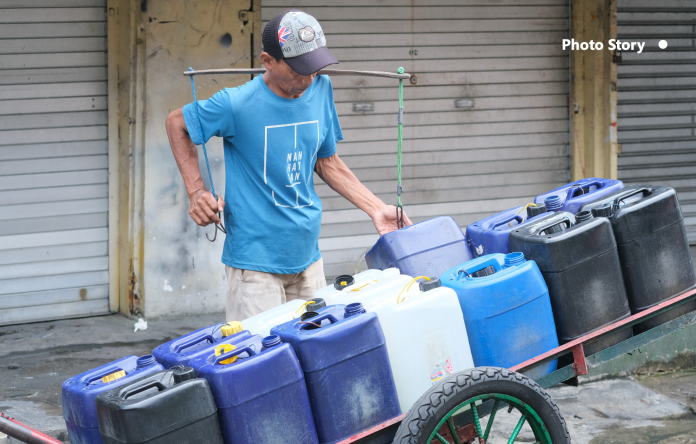

THE EDITOR – By 2026, Jakarta proudly projects the image of a sophisticated global powerhouse. Yet, beneath the shadow of its glittering skyscrapers, a quiet desperation grows as citizens clamor for a basic human right: clean water. Venturing deep into the capital’s claustrophobic alleyways, The Editor’s investigative team uncovered a grim truth—thousands of families remain bound to the mercy of street vendors, surviving day-to-day on the low rumble of mobile water carts.
Our editorial probe exposed a deep systemic divide, revealing that the vast majority of these forgotten communities are packed tightly into the margins of North and West Jakarta. On paper, this disconnected population represents a seemingly minor 18% of the city’s total footprint. But the real investigative pivot lies in the dark financial waters flowing behind closed doors: the cost to bridge this final gap and lay down new pipelines has ballooned to an staggering, astronomical Rp24 trillion.
EXCLUSIVE: The Stormy History of Jakarta’s Private Water Supply
The government has allocated a Rp24 trillion budget aimed at achieving 100 percent clean water coverage for Jakarta by 2030. This substantial financial deployment warrants further investigation into the project’s purpose and implementation.
An investigation into a Rp24 trillion infrastructure project reveals a paradox where a massive investment aims to provide water access to only 18% of the population, raising questions about efficiency and potential corruption. The analysis questions whether the project’s delay is intentional, serving to protect vested interests in the lucrative black-market water industry.
The cost is well over 23 trillion. To be exact, it is around 24 trillion, and it will be executed over the next three years until 2030 to reach the 100% target,” revealed Arief Nasrudin, the current President Director PT PAM Air Minum Jaya (Perseroda). He dropped this multi-trillion-dollar bombshell to The Editor after being cornered at Jakarta City Hall talk show titled Accelerating Jakarta’s Development Toward a Global City last Friday.
PAM Jaya’s 2025 e-procurement database requires the procurement of High-Density Polyethylene (HDPE SDR11 PN16) and specialized steel piping for main transmission corridors. These materials are selected for their ability to withstand high pressure and resist corrosion, with a projected lifespan of 50 to 100 years.
Internal financial blueprints reveal a pricing matrix for infrastructure, with raw reticulation lines (100mm-200mm) estimated at Rp 200,000 to Rp 700,000 per meter. The report highlights that this structure facilitates significant budget inflation for neighborhood-level projects.
Large-scale primary transmission pipes, measuring 500 mm and above, represent the most capital-intensive segment of water infrastructure with costs ranging from Rp 2,500,000 to Rp 5,000,000 per meter. These heavy-duty conduits are crucial for pumping raw water from central treatment plants into the city’s distribution network.
An investigation reveals that high-end shopping centers in Jakarta operate with a substantial water surplus, providing uninterrupted service. This scenario stands in contrast to utility stability issues recently reported in neighboring Malaysia. For more details, explore the full report.
Elite shopping centers in Kuala Lumpur, including Suria KLCC and Sunway Putra Mall, faced significant water crises in 2024 caused by burst pipelines, power outages, and contamination. Conversely, this vulnerability is rare in Jakarta, where citizens frequent malls to enjoy reliable amenities during city-wide power outages.
PAM Jaya claims to be prioritizing water distribution to North Jakarta, which is considered the epicenter of the city’s severe water scarcity. This focus highlights long-term, systemic neglect, prompting questions about why the northern coastal area has historically lacked access to the municipal water supply.
Consider the human cost: for impoverished families in West and North Jakarta, a basic necessity remains a distant promise scheduled for 2030. This systemic delay forces vulnerable populations to endure substandard living conditions, raising questions about urban equity and infrastructure prioritization.
Waiting three years is an unacceptably long timeline for communities seeking clean water free from the smell of rust. While a staggering Rp24 trillion budget is allocated on paper, residents are forced to spend significantly from their limited daily incomes to purchase jerrycans of water from mobile vendors.
WATER IS A NON-NEGOTIABLE BASIC HUMAN RIGHT
Jakarta’s global city ranking has marginally improved from 74 to 71, yet this progress belies significant local infrastructure challenges, specifically regarding water quality for average residents. A true global city must be measured by the living conditions of its citizens rather than just its skyline, according to a recent critique.
Public Policy Analyst Sugiyanto has raised sharp concerns, arguing that Jakarta remains focused on a mirage of physical development while fundamental needs like sanitation and clean water are treated as debated luxuries. This critical analysis suggests that basic infrastructure remains out of reach for many residents.
In every nation, clean water and proper sanitation are supposed to be an absolute baseline. In Indonesia, this mandate is explicitly written into national statutory law—it is completely non-negotiable, and local regional regulations are already in place to enforce it,” Sugiyanto stated firmly.
The investigative lens now focuses on the massive ambitions of state-owned utility PAM JAYA as it races against a suffocating deadline. A colossal Rp24 trillion investment is being poured into the ground to construct the final pipeline network before time completely runs out.
Sugiyanto warns that PAM JAYA’s sanitation targets are fundamentally the responsibility of the Jakarta Provincial Government, demanding immediate, locked-in milestones for public hygiene. This perspective shifts accountability directly onto city regulators to ensure progress in public sanitation.