

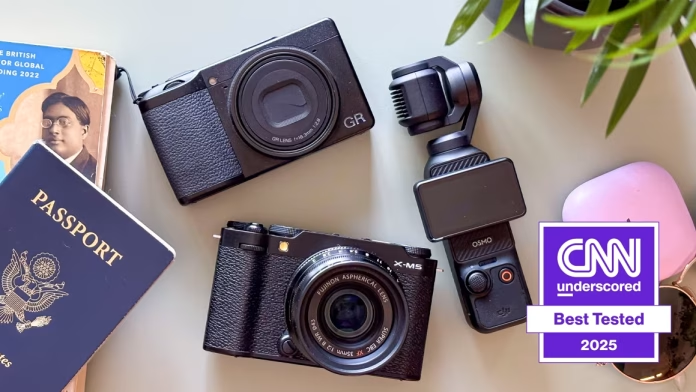

THE EDITOR – “I never go on a trip without the best travel camera in my bag,” said CNN reporters Michelle Rae Uy.
For her, people can always use their smartphone to capture all those travel memories. But even the latest iPhone with the most advanced camera is no match for an actual camera, especially a mirrorless one with a big APS-C or full-frame sensor, or an action camera with incredible video stabilization.
“I won’t get into the technical nitty-gritty of cameras, but as an experienced traveler and photo hobbyist, you can trust me when I say the photos and videos you’ll take with a proper camera are lightyears superior to anything you’ll ever take with your phone. I also find that taking photos with a camera is a more thoughtful endeavor and because of that, every exposure is much more valuable and has a lot more meaning than the hundreds of photos you take with a phone, many of which you likely won’t ever look at again,” She said.
So, if you truly want to capture your travel memories in the best light (pun intended), add one of the best travel cameras to your travel gear and throw it in your crossbody bag whenever you go sightseeing. She spent weeks testing 13 highly recommended travel cameras, including the top action cameras and some of the highest-rated point-and-shoot cameras and found three to suit your travel photography needs.
1. Fujifilm X-M5 – Best travel camera
This powerful yet beginner-friendly 2024 release from Fujifilm is perfect for capturing 4K and 6.2K travel vlogs and photos. It’s also unbelievably compact — just what you want to carry around while traveling. The price is around $899.
As someone who’s traveled the world lugging around a Sony a7R III, which is already relatively lightweight, in my weekender bag, I prioritize weight over superior performance — unless you’re a professional travel photographer and need that full-frame muscle. That’s one of the main reasons why the Fujifilm X-M5 made it to the top of this list.
While this mirrorless APS-C camera is a relative newcomer, hitting the shelves in November 2024, it’s proven to be a near-perfect contender in the entry-level camera scene. And one of the things I love about it is its compact, lightweight design. Traveling is tiring enough without the weight of a heavy camera around your neck, but the X-M5 is just the right size and weight to comfortably do so when exploring a European city or going on excursions around Asia.
If you’re worried about the camera being too compact, no need. The physical buttons aren’t too small, and the front grip is deep enough for bigger hands and fingers to control and securely hold. I put that to the test by asking a photographer/videographer friend of mine to take some photos with it, and he loved its handling — even though he’s 6-foot-2, has big hands and is used to operating bigger rigs.
If you want a compact camera, it should be this pocket-friendly one fitted with a large APS-C. It has several features that make it ideal for travel photography like hyperlocal distance and snap focus. The price is around $967.
Another reason the X-M5 is a great travel camera is that it’s beginner-friendly, meaning it’s incredibly easy to use even for folks who don’t know their way around cameras. Set it on auto, and you’ll still capture vibrant, sharp images. If you want to expand your skills later on, all the settings, dials and buttons are there to give you more creative control over your exposures.
The fact that it’s an interchangeable lens camera adds to its versatility and Fuji has a plethora of X-mount lenses to choose from. I did most of my testing with a 35mm f/2 lens, which is a 50mm lens on a full-frame camera, but you can get it with a more affordable XC 15-45mm f/3.5-5.6 one so you can have both wide-angle and telephoto shooting capabilities when you’re traveling.
The X-M5 is best for capturing well-lit, daytime scenes, but it proved capable enough to take great low-light and nighttime photos during my tests. And while its autofocusing and tracking aren’t necessarily pro-level, they can more than keep up when you’re shooting travel portraits and photos of walking (not running) lions during a safari trip.
Its highly-articulating LCD screen makes it great for vlogging and captures up to 6.2K video resolution at 30 frames per second. So, shoot as many travel videos as you want but know that it doesn’t have in-body image stabilization; if you’re shooting videos while moving, prepare yourself — I got a mild headache just watching the videos I took with it while walking. Also, know that the screen is dim in sunny conditions, so you might struggle to see the menu or what you’re taking a photo of when in bright light.
Still, the Fujifilm X-M5 is a fairly affordable camera, especially for its performance, quality, ergonomics and travel-friendliness. Currently, a kit with an XC 15-45mm lens will set you back less than $900, and you’ll likely find great deals during big sale events. Sure, you can get a cheaper travel camera, but if you want the best, you can’t go wrong with this one.
2. Ricoh GR III – Best compact camera for travel
If you mention to people that you’re thinking of getting a compact camera, you’re likely to come across someone who’ll tell you not to waste your time and stick with your smartphone instead. That’s fair enough if you think about how far the latest smartphones have come in their camera technology and how some compact point-and-shoot cameras, especially the older and cheaper ones, on the market aren’t all that impressive when it comes to image quality and autofocusing.
However, if you insist on bringing a compact camera on your trip, it might as well be the Ricoh GR III. It may look like a regular compact camera, but its autofocusing and subject tracking aren’t anywhere near the level of the Fujifilm X-M5. But it makes up for its inadequacies in a few big ways, leaving all other compact cameras in the dust.
The most impressive thing about it is that it has a large APS-C sensor fitted in a pocket-friendly body. That means it has a bigger sensor than the Sony RX100 VII or the Canon PowerShot G7 X Mark III — the two other top-of-the-class compact cameras — in a similar pocket-sized body.
This camera is what you’d get if the X-M5 and the RX100 VII had a baby. And while it’s a lot more complicated than this, generally speaking, the bigger the sensor, the better the image quality. Looking at the images I’ve taken with it, I wouldn’t have known they were taken with a compact camera if I hadn’t pressed the shutter myself.
And that’s only the beginning. Dan Savoie, technical solutions manager for Ricoh Imaging North America, clued me in on this camera’s many features that make it effortless for beginners and travel shutterbugs to get the right shot almost every time. That includes snap focus, which automatically sets the focus to your pre-specified focusing distance, and the hyperfocal distance feature that makes the camera use the greatest depth of field in scenes to ensure that most of the elements in the image are in focus. Both of these features have proven very useful in situations where I didn’t have the time to tinker with the settings and needed to capture a photo on the fly.
One thing that was disappointing to me, though, is the lack of optical or digital zoom capabilities, which many of the higher-end compact cameras offer. This camera’s version of zoom is a “crop” function that lets you change the field of view from 28mm to 35mm or 50mm, which gives you the illusion of zooming. It works well enough, especially if you only want to capture certain elements in your photos but don’t want to take the time to crop the images on your computer, but it’s still not the same.
Other than that, I have no complaints. Don’t be deterred by its over-$1,000 price tag either. Honestly, most compact cameras of this caliber won’t be cheap. Both the RX100 VII and the G7 X Mark III are priced higher, and if you opt for a cheaper fixed lens option, you’ll be less impressed.
3. DJI Osmo Pocket 3 – Best action camera for travel
his incredibly easy-to-use yet extremely versatile action camera from DJI will see you through all your travel video needs, especially if capturing beautifully steady footage is imperative. The price is around $519.
There aren’t many excellent action cameras on the market, so I truly struggled to choose the best one to recommend. Both the GoPro Hero 13 Black and the DJI Osmo Action 5 Pro feel like obvious shoo-ins for the best action camera for travel, but then there’s the incredibly fun Insta360 X4 which has a 360-degree shooting capability that makes it excellent for video “ussies”.
Still, if I were to look at all these impressive action cameras from a traveler’s perspective, I would only want to use the Hero 13 Black, Osmo Action 5 Pro or the Insta360 X4 for my adventure and water-related activity videos. On the other hand, the DJI Osmo Pocket 3 feels more natural to use in most situations.
The three action cameras mentioned above have impressive waterproofing whereas the Osmo Pocket 3 does not. But because it’s essentially a gimbal-camera hybrid, it would be imprudent to use it underwater anyway. However, from exploring an old city center of some European town to hiking the Inca Trail to reach Macchu Pichu, it’s a heck of a versatile camera. I even used it to record press events and all the other attendees were salivating just seeing it in action.
It’s pocket-friendly, but because it’s longer than the Hero 13 Black and the Osmo Action 5 Pro, it’s much easier to hold without an extension pole. Get its extra battery pack and mini tripod, as I did, and you should be all set to shoot your photos and videos — as a bonus, you’re also getting that extra grip space. The Osmo Pocket 3 offers several shooting modes for you to enjoy, including photo, panoramic photo, slow motion and timelapse.
Because it is essentially a gimbal, it has fantastic subject tracking and is excellent at keeping your framing straight (within the gimbal’s endpoints, of course) so you don’t even have to try to make your 4K videos look good. Take your eyes off the screen and enjoy your explorations instead — just check it now and then.
Speaking of the LCD screen, it’s one of the best I’ve seen on a camera, action or otherwise. It’s tiny but it also offers incredible visibility even in full sun. Plus, it comes with a plethora of useful functions. Not only is it touchscreen so you can use it to access the menu and change settings, switch recording modes, preview your clips, zoom in and out, and operate the gimbal, but it also lets you effortlessly switch from landscape to portrait (or turn the camera on and of) by merely flipping the display. Flip the display horizontally to turn it on or switch to landscape mode; flip it vertically to turn it off or switch to portrait mode. It’s ingenious.
My biggest gripe is that the device gets hot when recording on a warm day. It’s also pricey at a little over $500. However, considering all it offers and that it’s so easy to use, you’re getting a high-achieving camera that will get you the best footage (and images) of your trips. That’s more than a fair trade.
How She Tested
Testing 13 cameras wasn’t easy, especially because I wanted my product pool to consist of different camera types for various people’s needs. Some prefer to travel with a compact point-and-shoot camera while others require an action camera to record their adventures. So, I tested each camera the way the manufacturers intended while keeping my test parameters and judging criteria fair. After all, a compact camera won’t be as good as a typical APS-C or full-frame camera, and a mirrorless camera’s stabilization can’t compare to an action camera.
To do this, I tested the cameras in three groups, starting with the mirrorless SLR cameras, then the compact models and finally the action cameras, taking them all over Los Angeles to see how they would perform in different lighting situations.
I didn’t include any instant cameras in my testing — if you prefer to capture your travel memories with one, check out my best instant camera guide instead. Nor did I include any drones (maybe we’ll do a guide of the best drone in the future) apart from the Hover Air X1 Pro, which is a follow-me drone that’s designed for selfies and ussies rather than traditional aerial photography.
I then evaluated each camera using the following primary criteria:
Performance
- Image quality: No matter how cool a camera is, if the image quality isn’t clean, sharp and detailed, no photographer in their right mind would call that camera great — unless of course, you’re going for that retro, dreamy, lo-fi look that plastic and toy cameras are known for. Because most travelers aren’t trained in photography and don’t care much about things like dynamic range, noise reduction or artifacts like purple fringing, I didn’t pay much attention to those in my review. Rather, I kept it to the very, non-technical basics, taking photos in full sun and low lighting conditions.
- Video quality: Because many travelers want to take videos of their trips, I also recorded videos with each camera, testing its motion stabilization features (if available) and paying attention to any rolling shutter issues. Naturally, I also judged each camera in terms of available video resolution.
Design
- Ease of use: While I tested each camera’s manual controls, I mostly focused on how intuitive it is for folks who aren’t camera savvy. After all, most people these days take photos with their smartphones and may not know how to turn on a mirrorless camera — this isn’t a judgment, just sharing from experience. So, I tested each model how a layman would use it to gauge its ease of use. Not all cameras have a viewfinder, so I also tested each camera’s screen to see how visible the display is in full sun.
- Portability: As mentioned, I’m an advocate for keeping things light when you travel. Do you think it’s easy to lug around a full-frame mirrorless camera? Try doing it for hours in the middle of summer while walking around in a hot, humid climate. It’s not for the faint of heart, especially if that camera has a heavy telephoto lens attached to it. So as an experienced traveler and photographer, I truly recommend prioritizing portability, which is why I prioritized this metric during testing.
- Features: Useful features add value to a camera, so I made sure to check things like subject tracking, autofocusing, effects and filters and even Wi-Fi or mobile connectivity.
- Versatility: Does the camera have interchangeable lenses? Does it offer optical or digital zoom if it has a fixed lens? Does it have additional features that make it a great all-rounder? These are some of the questions I tried to answer during testing.
