

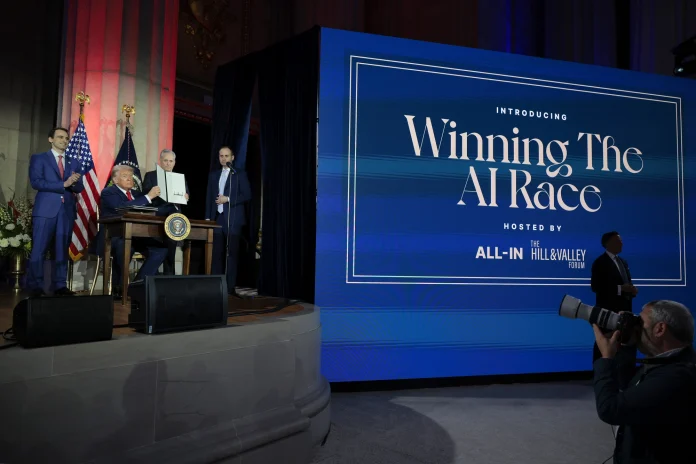

THE EDITOR – Last week President Donald Trump’s artificial intelligence policy took a fresh twist with his latest executive order, launching a “Genesis Mission” that claims to accelerate scientific research and bolster U.S. competitiveness by using AI. The order came wreathed in grand rhetoric, including comparisons to the Manhattan Project and the Apollo program.
But for all that Trump touts the importance of American leadership in AI, in reality he’s spent much of his presidency hobbling it.
Politico on 3 December 2025 said that Trump’s AI doctrine has focused on boosting tech companies friendly with the administration, helping them dominate every aspect of people’s lives and the economy. The doctrine is driven by the idea that the United States wins the AI race if these companies control global AI — even at the cost of our kids’ mental health, gutted jobs, polluted skies and higher utility bills.
The recent executive order may seem like a welcome pivot to using AI rather than just building AI infrastructure. But unfortunately for American leadership in AI, it’s just a small step forward after three giant leaps backward. A serious effort to achieve America’s aspirations with AI has to start by reversing Trump’s damage to critical government functions.
The first giant leap backward has been a dangerous weakening of public data, the raw material required to train AI models. The federal government collects troves of data that families and businesses use every day — traffic patterns and census information, nutritional assessments and air quality reports, soil data and economic measures.
The executive order rightly focuses on the importance of data to “unleash a new age of AI-accelerated innovation and discovery.” But this comes after the administration has spent months ordering agency after agency to delete or hide data that’s politically inconvenient, and indiscriminately firing employees including those who manage valuable datasets.
Here’s what that means for AI advances. Initial research shows the eye-popping potential for AI weather forecasts that could be precise down to a city block or accurate as far ahead as a month. But that’s only possible with the sensor data that the National Oceanic and Atmospheric Administration (NOAA) collects and curates from weather stations, ships, balloons, aircraft, satellites and buoys. The Trump administration has reduced weather balloon launches and removed hundreds of agency staff. It plans to cut back on NOAA satellites and shutter more than a dozen facilities that gather and curate data.
Politics, not policy, is guiding these decisions. As this administration tries to blind us to climate risks, it is putting Americans at risk today by undercutting conventional weather and disaster forecasting — and it’s diminishing the prospects for one of the most powerful and globally significant advances that AI could bring us.
The data problem doesn’t stop at weather. The Trump administration has also disrupted the collection of important health data. One example is data the Centers for Disease Control and Prevention gathered for nearly four decades from a representative sample of volunteers to understand risks in pregnancy.
That valuable data now remains scattered and hard to access, because the CDC first shuttered the database to avoid collecting data on race and ethnicity in line with the administration’s executive order against “DEI,” and then placed the staff on administrative leave. That makes it harder to learn why Black maternal mortality is more than twice the national average, or how to protect all mothers and newborns. Data on vaccine safety, farm labor, hunger, greenhouse gas reporting and international development have also been deleted or degraded.
For AI to be effective against these immensely complex challenges, the smarter move would have been to expand data collection and support the agency staff who make sure datasets are robust and accessible.
The second backward move is Trump’s cuts to federally funded research. With steady support from Congress over successive administrations, eight decades of federal research funding made it possible to start new industries, prevent and cure diseases, deter potential adversaries, understand and start to manage environmental risks and expand the boundaries of human knowledge. This research base is where AI itself came from, and to harness AI for the next generation of advances, federal support is essential.
Instead, the Trump administration has frozen grants, attacked leading research universities, curtailed high-talent immigration, ousted thousands of research agency staff and proposed a $44 billion reduction in federally funded research and development — the largest single-year cut in history.
While some take solace in the administration’s cuts sparing specific budget lines for AI research and the new executive order for Energy Department research using AI, that’s like buying more tractors while you kill off your crops. AI is a tool, not the goal itself. The federal government needs to fund not just AI researchers, but researchers in the full range of promising fields that need AI to advance — for example, biologists, materials scientists and meteorologists. It is their knowledge that will help develop AI for more effective medicines, resilient infrastructure and disaster warnings. And that’s how we create new industries that will help America maintain its global economic leadership. Trump’s cuts to publicly funded research mean lost opportunities, delays in breakthroughs and American researchers recruited to other countries hungry for our talent.
The third backward leap is the administration’s opposition to policies that protect people. The foundation for all AI applications, current and future, has to be managing AI’s risks. The obvious reason for this is the real harms that are already materializing: bot-encouraged suicides, deepfakes nudes, worker surveillance and job loss, and new forms of fraud. In addition, AI advances won’t meet their potential if people don’t trust the technology.
Nonetheless, the Trump administration and its allies in Congress are trying to undo or preclude state laws that protect Americans from real harms. While the previous congressional attempt at a moratorium on state AI laws failed 99-1 in the Senate, the White House has been itching to try again, and some in Congress are looking for ways to revive this misguided policy.
The American people have a different view. A recent Pew poll found that 50 percent of Americans are more concerned than excited about AI, while only 10 percent are more excited than concerned. Democratic and Republican voters across dozens of polls strongly support AI regulations. Effective regulation of industrial production reduced pollution. Effective regulation for seat belts saved hundreds of thousands of lives. AI is an even broader technology that will reshape so many facets of our lives. It needs effective regulation that builds trust, so Americans can seize the beneficial advances AI can provide.
To be sure, the Trump administration has done some good on AI. For example, it is expanding a pilot of the National AI Research Resource to support researchers and startups with AI computing resources, and it has embraced open source and open weight AI models that are increasingly important in the global AI race. The recent order on AI for science could make some advancements in accelerating how AI is used in scientific domains, though it remains to be seen how this work is executed.
But these are modest elements compared to the rest of the Trump AI agenda — a series of measures that focus on providing expensive chips and datacenters for the world’s richest companies.
AI is a powerful technology that can help America meet its great ambitions. A different, better AI doctrine would recognize that the work ahead is much more than supercomputers, data centers and chips. It would recognize the expansive possibilities of AI beyond today’s narrow commercial focus, move nimbly to manage risks, and boost our national capacity to develop and deploy AI applications that transform Americans’ lives. It would define larger national objectives that public and private organizations achieve together, rather than ceding our future to a small group of billionaires whose most obvious imperative is the valuations of their companies, not the value they add to our lives.
