

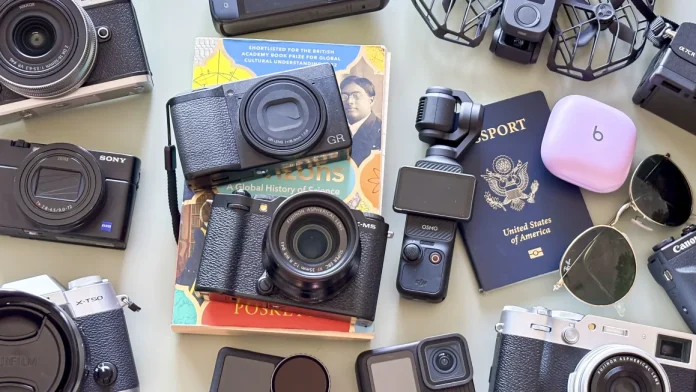

THE EDITOR – There’s no right photography gear for everyone. Yes, some cameras perform better than others, and some excel at specific things. But when it comes to choosing the camera, lenses, tripods and even camera bag that will suit your needs, it all still boils down to your personal preference.
CNN reporters Michelle Rae Uy said that She can go on all day about what cameras are best but ultimately, you decide what travel camera is best for you. And there are several factors you should consider before making your decision based on her experience.
What kind of a traveler are you?
Are you a wilderness backpacker or do you prefer staying at fancy resorts and spending a good chunk of your time pampered at the spa? Do you mostly go on beach vacations, city getaways or rugged adventures? What’s more, do you like seeing unique landmarks, epic landscapes or grand architecture? Or are you a fan of all of the above?
Knowing the type of traveler you are will give you a clue as to what travel camera will best serve your needs. For example, a GoPro wouldn’t be the ideal camera to capture the opulence of Venetian architecture, unless you’re after GoPro’s specific aesthetic. An expensive mirrorless camera isn’t ideal if you spend most of your time doing water sports; not only will you need underwater housing and gear, but it might be too clunky to use when surfing.
She love the look and feel of the relatively inexpensive Nikon Z fc. “It’s impossibly lightweight, which makes it an ideal travel camera candidate, and it’s simply gorgeous in a nostalgic way. It reminds me of some of the 35mm film cameras I’ve owned in the past. More importantly, it delivers beautifully warm images and is great for filming travel vlogs in 4K, thanks to its articulating screen that offers good visibility even when taking photos in full sun,” She said.
So, why didn’t this get the coveted top spot? What’s fun about this camera is that it has a lot of physical controls that will please the more experienced travel photographers. Unfortunately, those also put it at a disadvantage as they make it a little trickier to use, especially if you don’t have much experience with cameras. Most travelers wouldn’t want to tinker with all those knobs and dials anyway.
“I love this camera but it’s probably best for seasoned photographers who get their kicks shooting on manual,”.
Experienced travel photographers who want a full-frame camera will love this one from Sony. She admit that she may be biased, being a Sony mirrorless fan, but had the Sony a7CR been released around the same time as my a7R III, it would have been my first choice, despite its higher price.
For a full-frame, it has a relatively small footprint and weighs less than Sony’s not-made-specifically-for-travel models, which is just what you need if you want highly detailed, high-quality photos for your trip to a far-flung destination. It captured truly stunning images during testing and as is Sony’s signature, its auto-focusing and subject tracking are incredible, making it great for wildlife photography.
“It’s just too bad it’s a whopping $3,000 — and that’s for the body alone. I’d spend that money, being an experienced hobbyist, but most travelers wouldn’t,”.
Noticeably bigger than the X-M5 (though not by a lot), the mid-range Fujifilm X-T50 is also a much more capable camera than my top pick, thanks to its higher resolution sensor. If you’re a hobbyist, you’ll appreciate that it comes with a viewfinder, as well as its better image stabilization performance, thanks to that fancy sensor-shift stabilization feature. Despite having more advanced features, it’s still a camera that beginners can easily use and grow into.
However, as far as its handling, She wasn’t quite convinced it was the perfect camera to travel with. Not that its ergonomics are subpar; it’s not exceptionally heavy. It’s just not as comfortable to handle as the X-M5, and when you’re traveling, you’d want a camera that feels like a natural extension of your hand.
That and the fact that it will set you back more than the X-M5 makes me hesitant to recommend it to most travelers. If it’s a good travel camera you want, there are more affordable options that will perfectly suit your needs.
Other compact cameras She tested
Her first mirrorless camera was the Fujifilm X100, and She was absolutely enamored with it. Sadly, some soulless individual took her from me when I was staying at a resort in Mexico.
“I never saw her again. I’m happy to report though that this much-beloved classic (at this point) is still as great as ever, with its latest iteration touting a few modern features,”.
With a fixed, pancake lens, this looks and feels like a vintage 35mm point-and-shoot. It has the simplicity of it too, making it a great travel camera to bring with you on your slow-paced holidays. Because of its lens, it only offers digital zoom, but that should suffice, especially if you have a penchant for street, landscape and architectural photography. It does well as a portrait camera too, especially if you want those travel selfies to post on Instagram.
Still, the Fuji X-M5 offers a bit more versatility to folks who aren’t as experienced with photography, and unfortunately, the X100 VI is also a pricey investment.
If you’re seeking another compact camera, the Sony RX100 VII is a great alternative to the Ricoh GR III — especially if you want optical zoom capabilities. Like other Sony cameras, you can rely on this to take good photos and 4K videos. And when you’re done, you can slip it back in your pocket or travel belt bag. Easy peasy.
However, with its small 1-inch sensor, you cannot expect the highest-quality images. It’s also a bit of an oldie as it was released in 2019. It’s slow to buffer when storing newly taken photos and doesn’t do well in low lighting. There are better options considering you’re paying more than $1,000 here.
Comparable to the Sony RX100 VII in design, class and image quality and having been released around the same time, the Canon PowerShot G7X Mark III has its merits. In fact, like the RX100 VII, it’s one of the best travel cameras you can get if you want a pocket-friendly model and money is no object.
Sadly, the G7X Mark III is left in the dust when it comes to impressive features. Its autofocusing isn’t as fast as the RX100 VII, and neither its zoom range nor its focal length is a match. Add those to the fact it’s more expensive right now and it’s a hard sell. Unless, of course, you prefer Canon’s color profile and simpler menu to Sony’s.
There are so many things to love about the Insta360 X4. This viral action camera, unlike my action camera pick, offers waterproofing up to 33 feet (10 meters). It has a big, vibrant touch display, and it’s so easy to use — in fact, its menu is more beginner-friendly than GoPro’s head-scratching one.
But the best thing about this camera is that it captures 360-degree 8K footage, made possible by its dual lenses that are strategically sitting on either side of the camera. But you don’t have to use that 360-degree view; Insta360’s brilliant mobile will let you edit every clip so you can turn, adjust and cut your footage to produce a dynamically creative final video. It’s just what you want when you’re off on wild adventures.
“So, why didn’t I pick this as the best action camera? It boils back down to versatility. Its uber-wide angle view isn’t ideal for taking travel photos and certain travel videos,”.
“The people I’ve shown the Hover Air X1 Pro to were fascinated by it. It’s a cool concept. Some people have a negative reaction to drones, but this follow-me drone with preset flying modes is designed for low-flying. After all, it’s only following and focusing on you, not flying overhead and filming those around you. In my experience, people don’t see it as much of an invasion of their privacy when it’s flying at human height level — at least based on the reactions I’ve gotten from strangers while testing it around Los Angeles,”.
What’s also so great about it is that it’s so easy to use. Its flying and filming presets will allow it to do its thing, so you don’t have to control it yourself. I’ve never flown a drone before, and I familiarized myself with this one in less than an hour.
It’s not ideal for capturing all your travel memories, but it’s great for recording your adventures, taking group videos and more. Plus, it’s pocket-sized.
Perhaps because GoPro is a pioneer, the brand remains the most well-known in the mainstream, even though its competitors have rolled out action cameras with more impressive upgrades.
Take the DJI Osmo Action 5 Pro, for example. As the GoPro Hero 13 Black’s biggest rival, it boasts a hefty list of things that it does better. Thanks to its larger, higher-resolution sensor, it has a better dynamic range, producing more detailed videos and images. Both its OLED screens have touch capabilities. It also has better waterproofing, surviving up to 65 feet of submersion without a case, and noticeably longer battery life.
So, even though it lacks 5.3K video and doesn’t have the Hero 13 Black’s Lens Mods feature, it has my vote. I still prefer the Osmo Pocket 3 in terms of versatility and ease of use, but it’s clear that DJI knows what it’s doing when designing its action cameras.
When it comes to innovation, GoPro remains king. From its 5.3K video that looks gorgeous and slow motion recording of up to 400 frames per second to the new Lens Mods feature that allows you to slap on lenses and filters to the camera’s lens to change its field of view or fine-tune the exposure based on the lighting conditions, this newest version of this action camera is a little fancier than the competition.
“I wish GoPro directed some of these improvement efforts to the camera’s basics. For example, it has the same sensor as previous versions, and its low-light performance remains subpar. Plus, its waterproofing without housing is still at just 33 feet — half that of the DJI Osmo Action 5 Pro,”.
“Since it’s about $50 pricier than the Osmo Action 5 Pro, it’s hard to look past these inadequacies — especially if you don’t need to slap on those lens attachments. And let’s face it; more regular travelers won’t,”.
