

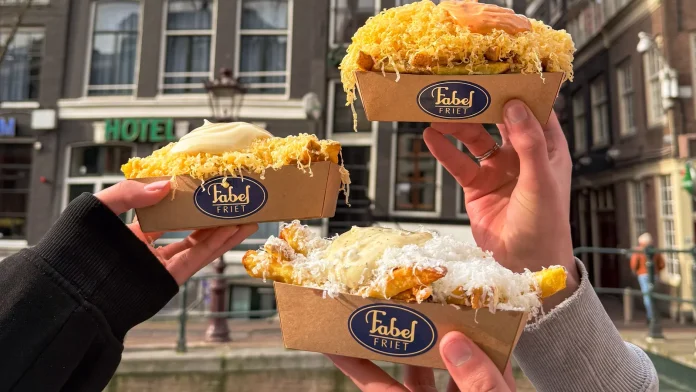

THE EDITOR – Thomas A P van Leeuwen has a riveting view from his Amsterdam flat. His street, Keizersgracht, is lined with imposing 17th-Century canal houses – but what the academic and author sees each day is distinctly modern. Day after day, tourists form long queues on the bridge, holding up €5.50 (£4.80) cones of fries against the gabled backdrop for TikTok or Instagram posts.
Apeksha Bhateja a journalist from BBC Travel on 6 December 2025 write beautiful story about this situation, start with FabelFriest. FabelFriet is the place to get fries in Amsterdam. The brand opened its first shop in 2020 and blew up on TikTok in 2023; ever since, its original location in De Negen Straatjes (Nine Streets) neighbourhood has drawn constant lines. Signs and staff manage the crowds, sending chip-seekers down the bridge and along the pavement. A few metres away, Korean sandwich shop Chun has similar queues, while the prettily packaged cookies at Van Stapele Koekmakerij have become another viral Amsterdam pilgrimage.
Amsterdam is far from the only city where people are salivating over food. In New York’s West Village, L’Industrie draws hour-long queues for a slice of pizza. Getting a salt beef bagel at London institution Beigel Bake is a test in loyalty and patience, while Japan’s I’m Donut? craze has gone global, with a New York outpost generating constant lines. Meanwhile Italy’s All’antico Vinaio has tested its fame in the UK and the US, with patrons lining up for its freshly baked schiacciata (Tuscan flatbread) sandwiches.
Across the world, travellers are now willing to wait an hour or more for trendy takes on everyday staples. Saturday Night Live even did a parody on the phenomenon. But psychologists say that these lines aren’t really about the food at all; they reveal how social media, status and performance are reshaping modern travel.
WHY QUEUES SEDUCE US
A queue doesn’t just signal popularity, it triggers powerful psychological cues. The fear of missing out (FOMO) is the strongest explanation for why people wait for food they’ve only heard about, says Rachel S Herz, adjunct assistant professor of psychiatry and human behaviour at Brown University Alpert Medical School and author of Why You Eat What You Eat. “For positive experiences, when people see other people in line for something, it makes the ‘thing’ people are queuing up for seem more desirable and elicits FOMO.”
Cathrine Jansson-Boyd, professor of consumer psychology at Anglia Ruskin University, explains the mechanism as “social proof of validation”. If you keep seeing people queue over and over, she says, the repetition can make the behaviour feel normal – even expected – and that can subtly change how you respond. “You’re a little bit scared of missing out,” she says.
But these days, queues are rarely encountered accidentally. Most people have already seen the food online before they arrive, and discovery happens on personalised feeds, not in the street. The pressure to do things that others are doing has increased, says Jansson-Boyd. “It does change us because we are very social and we want everybody to see what we’re doing and want to do what others are doing.”
But FOMO alone doesn’t explain why people now film themselves waiting in line, or why the food becomes a backdrop rather than the point. The psychology of queues is increasingly bound up with something newer – and far more visible.
TRAVEL AS PERFORMANCE
Whether we realise it or not, waiting in line for trending food is all part of a broader performance. People aren’t just eating the viral food – they’re filming themselves doing it, with their subsequent posts indicating to others that they’re onto something special. From cronuts to croffles, viral dishes spread across TikTok and Instagram before the travellers arrive, and millions watch others try them on camera.
“[Social media] gives tourists a stage on which to perform their vacation,” explains Sara Dolnicar, a professor at UQ Business School, The University of Queensland. A quick TikTok search for #stroopwafel or #friet (fries) brings up thousands of videos of travellers rating “viral foods” while aesthetically filming themselves in line or outside the venue.
Barbora Labudová sees this performance play out daily at FA Stroop Stroopwafels in Amsterdam, where tourists line up for the eponymous crispy biscuits layered with caramel and topped with strawberries or pistachios. Every day, she has to request phone-wielding customers to not film her as she prepares their treat.
Celebrities and influencers amplify the cycle, adds researcher Stefan Gössling, a professor at the School of Business and Economics, Linnaeus University. They are tirelessly collecting social capital to identify the next hyped place to stay relevant, with their followers imitating the aspirational behaviour to show that they are part of the same community. “That [tendency to imitate] is essentially the root course for the repetitive travel patterns [and] repetitive behaviour at the microscale, where people go to the same bakery to the same doughnut store to the same burger shop,” he says.
And because so much of this performance now happens online, the places people visit aren’t discovered through wandering; they’re delivered by algorithms. That changes not just how travellers behave, but where they go in the first place.
THE ILLUSION OF DISCOVERY
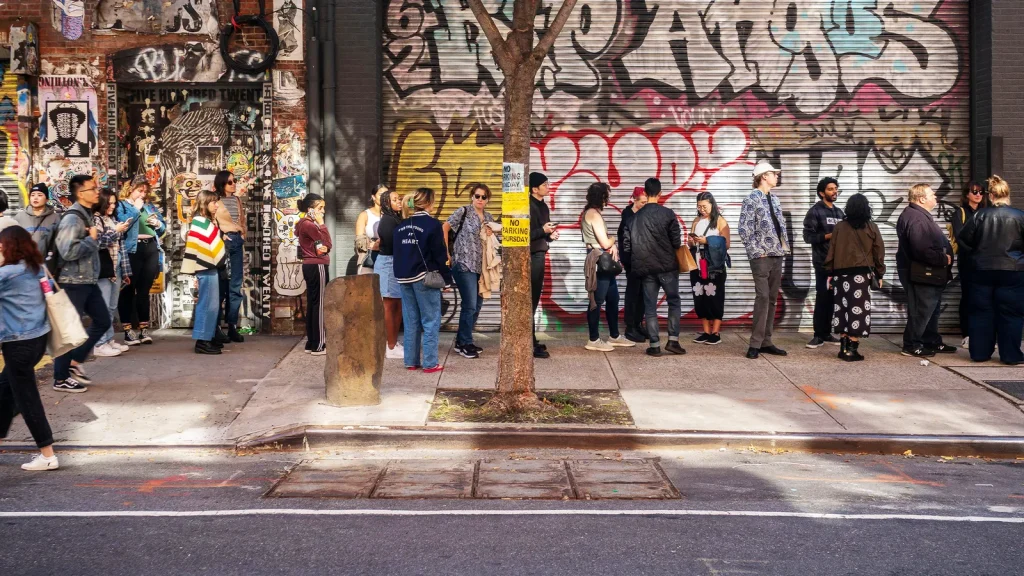
FOMO drives people to wait for hours for a taste of whatever the internet has decided is unmissable (Credit: Alamy/BBC)
Travel TikTok has created a sense that everyone is “finding” the same hotspot simultaneously – even though the algorithms are doing the work. Dolnicar notes that online searches reduce travellers’ cognitive load. “Maybe waiting in queues, then, is easier for people [than putting] in the effort and discover gems off-the-beaten track.”
But it comes at a cost. Algorithms prioritise what is already popular, not what is diverse or under-the-radar, which means the same places are pushed to millions of people at the same time. Moreover, these platforms reward content that elicits emotions and drives clicks and shares, thus further distributing the popular content. But virality is difficult to predict and control, and the meteoric rise is as much a strain on existing infrastructure as an economic opportunity.
What starts as a viral trend can quickly reshape entire neighbourhoods.
For example, when hordes of travellers end up at the same gelato shop in Rome or the same chip shop in Amsterdam, locals face the negative consequences of litter, noise and mismanagement. “Making a tourist hotspot even ‘hotter’ tends not to bring many benefits,” says Dolnicar. “Rather, there is a substantial risk of community backlash as the quality of life of locals can suffer.”
It is this never-ending onslaught of tourists that has driven Van Leeuwen to fight the chip craze. Along with other neighbours in De Negen Straatjes, he is demanding that the city review the shop’s licence. There is a larger conversation happening in the city about overtourism – activist group Amsterdam heeft een keuze (“Amsterdam has a choice”) has filed a lawsuit against the city for failing on their promise to limit tourist numbers to 20 million annually.
Still, crowds rarely deter people. Seeing others in line “gives you confidence that you’re doing the right thing,” Gossling says.
Even when travellers know the queues are fuelled by hype, they keep joining them – proof that, for many, the wait has become as meaningful as the meal.
